






12 November 2006
The sponsor of our project
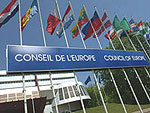
About the Council of Europe
 Origins and membership
The Council of Europe is the continent's oldest political organisation, founded in 1949. It:
• groups together 46 countries, including 21 countries from Central and Eastern Europe,
• has application from two more countries (Belarus and Montenegro),
• has granted observer status to 5 more countries (the Holy See, the United States, Canada, Japan and Mexico),
• is distinct from the 25-nation European Union, but no country has ever joined the Union without first belonging to the Council of Europe,
• has its headquarters in Strasbourg, in north-eastern France.
|
Aims
The Council was set up to:
• defend human rights, parliamentary democracy and the rule of law,
• develop continent-wide agreements to standardise member countries' social and legal practices,
• promote awareness of a European identity based on shared values and cutting across different cultures.
Since 1989, its main job has become:
• acting as a political anchor and human rights watchdog for Europe's post-communist democracies,
• assisting the countries of central and eastern Europe in carrying out and consolidating political, legal and constitutional reform in parallel with economic reform,
• providing know-how in areas such as human rights, local democracy, education, culture and the environment.
Political aims
The Council of Europe's Vienna Summit in October 1993 set out new political aims. The Heads of State and Government cast the Council of Europe as the guardian of democratic security - founded on human rights, democracy and the rule of law. Democratic security is an essential complement to military security, and is a pre-requisite for the continent's stability and peace.
During the Second Summit in Strasbourg in October 1997, the Heads of State and Government adopted an action plan to strengthen the Council of Europe's work in four areas: democracy and human rights, social cohesion, the security of citizens and democratic values and cultural diversity.
The Council of Europe's third Summit of Heads of State and Government, held in Warsaw on 16 and 17 May 2005, concluded by adopting a political declaration and an action plan laying down the principal tasks of the Council of Europe in the coming years:
- promoting the common fundamental values of human rights, the rule of law and democracy;
- strengthening the security of European citizens, in particular by combating terrorism, organised crime and trafficking in human beings;
- fostering co-operation with other international and European organisations.
Today, the Organisation continues to grow while at the same time increasing its monitoring to ensure that all its members respect the obligations and commitments they entered into when they joined.
How it works
The main component parts of the Council of Europe are:
• the Committee of Ministers, composed of the 46 Foreign ministers or their Strasbourg-based deputies (ambassadors/permanent representatives), which is the Organisation's decision-making body.
• the Parliamentary Assembly, grouping 630 members (315 representatives and 315 substitutes) from the 46 national parliaments. The current President is René van der Linden (the Netherlands, EPP/CD).
• the Congress of Local and Regional Authorities, composed of a Chamber of Local Authorities and a Chamber of Regions. Its current President is Halvdan Skard (Norway, SOC)
• the 1800-strong secretariat headed since September 2004 by Secretary General Terry Davis (United Kingdom, SOC), former Vice-President of the Parliamentary Assembly and former President of the Socialist Group of the Assembly.
Ordinary budget
In 2006, 190 148 800 euros.
Some practical achievements
• 200 legally binding European treaties or conventions many of which are open to non-member states on topics ranging from human rights to the fight against organised crime and from the prevention of torture to data protection or cultural co-operation.
• Recommendations to governments setting out policy guidelines on such issues as legal matters, health, education, culture and sport.
The pan-European dimension
Since November 1990, the accession of 21 countries of central and eastern Europe has given the Council of Europe a genuine pan-European dimension, so that it is now the organisation that represents Greater Europe.
15.06.2006
Source: http://www.coe.int
16:30 Posted in Nos parrains - Our sponsors | Permalink | Comments (0)
The sponsor of our project
Gérard Chaliand
Writer and geostrategist
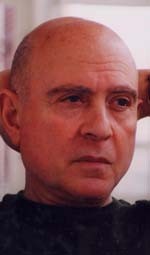
Gerard Chaliand passed more than twenty years in some 75 countries of Africa, Asia and America, from where it drew a series from investigations and tests. Man of ground above all, it was with the meeting of several national liberation movements: Algerian, Vietnamese, Palestinian or Afghan, to apprehend their fight of the interior.
Course:
- Doctorate of third cycle, university Paris V, Sorbonne, Paris.
- Between 1980-1989: Lecturer to the ENA.
- Between 1993 and 1999 teacher at the Higher school of War, Paris.
- 1997-2000: Director of the centre European of studies of the conflicts, Foundation for the studies of Defence.
Bibliographie :
Gerard Chaliand wrote many articles in the national and international reviews.
He is the author of more than 35 works, of which:
- Puissances et influences, annuaire géopolitique et géostratégique(Powers and influences, geopolitical and geostrategic directory), co-dirigé avec A. Blin et F Géré, Paris, éd. Mille et une nuits, 2000
- Anthologie mondiale de la stratégie. Des origines au nucléaire (World anthology of the strategy. Origins with the nuclear power), Laffont, 2001
- L’Arme du terrorisme (The Weapon of terrorism), Audibert, 2002
- America is back : les nouveaux césars du Pentagone (America is back: new the césars of the Pentagon), avec Arnaud Blin, Bayard, 2003
- Mémoire de ma mémoire (Memory of my memory), Julliard, 2003
- De l’Esprit d’aventure (Spirit of adventure), avec Patrice Franceschi et Jean-Claude Guilbert, Arthaud, 2003
15:55 Posted in Nos parrains - Our sponsors | Permalink | Comments (0)
The sponsor of our project
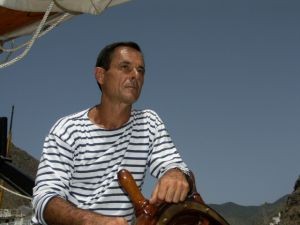
Franceschi Patrice
Writer, scenario writer, adventurer and explorer
President of the Company of the French Explorers, large medal of the exploration of the Company of Geography. For 25 years, it has multiplied forwarding throughout the World (Pygmies of Africa, Indians of Amazonian, Papous of New Guinea etc.) and of many humane missions in the zones of war (Afghanistan, Bosnia, Somalia, Kurdistan etc), it is one of the founders of ONG "solidarity". Untiring adventurer, it made a success of the first turn of the world into extra-light motorized (U.L.M).
He is currently Captain of the ship of exploration "the sulky person" and produces a turn of the World devoted to the "people of water" (website: http://www.la-boudeuse.org).
Patrice Franceschi is also Member of the central Commission of the Company of geography, like member of the team of research "contemporary rationality" in the Sorbonne.
Bibliography :
Patrice Franceschi is the author of about fifteen works, accounts, novels, tests of which:
| - Chasseur d'horizons (Hunter of horizons), Filipacchi (1991) |
| - Quelque chose qui prend les hommes (Something which takes the men), Robert Laffont (1993) |
| - Tout l'or du fleuve (All the gold of the river), Ramsay, (1997) - De l’esprit d’aventure (Spirit of adventure), Arthaud, (2003), coécrit avec Gérard Chaliand et Guilbert J-C
|
Cinématography :
He is also the realizer of a score of films, documentary, of which:
- La folle équipée (Mad expedition), Interscoop-Adidas, Garcin (1987)
- Les 33 Sakuddeï - France 2 / Télé Images / Voyage (2001)
- Sur la piste de Wallace (On the track of Wallace) - France 2 / Télé Images / Voyage (2001)
- Les mystères de la Sungaï Baï (Mysteries of Sungaï Baï) - France 2 / Télé Images / Voyage (2001)
- Au-dessus des volcans (Above the volcanos) - France 2 / Télé Images / Voyage (2001)
15:45 Posted in Nos parrains - Our sponsors | Permalink | Comments (0)
The sponsor of our project
Claudie HAIGNERE
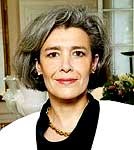
Born on May 13, 1957 in Creusot
Doctor, rheumatologist, specialist in aeronautical medicine,
Docteure ès-sciences, option Neurosciences,
Member of the Academy of Technologies.
From 1990 to 1992, person in charge for the programmes of physiology and space medicine to Division life sciences of the CNES in Paris, Claudie Haigneré takes part in the orientations of space research in this field in close cooperation with the French and international laboratories. It ensures, of 1989 to 1992, the scientific coordination of Franco-Russian mission ANTARES for the experiments of the life sciences.
August 17, 1996, Claudie Haigneré begins a 16 days flight on board orbiting station Russian MIR within the framework of Franco-Russian mission CASSIOPEE and carries out many médico-physiological, technical and biological experiments.
In May 1998, it joined the City of Stars as temporary astronaut for the Franco-Russian mission PERSEUS which begins in February 1999 on board MIR. It follows a complete training of engineer of edge of the station and cosmonaut rescuer of Soyuz vessel.
In November 1999, it is integrated into the space Agency European and joined the body of the European Astronauts in Cologne in Germany.
In January 2001, it again joined the City of Stars for a 9 months drive for mission ANDROMEDE. First French astronaut to fly on board International Space Station (ISS), Claudie Haigneré, engineer of edge n°1, carries out an experimental program in the fields of the observation of the Earth, of the study of the ionosphere, the life sciences as well as sciences of the matter.
In 2002, it is named Minister delegated to Research and New Technologies.
In 2004, it is named Minister delegated to the European Businesses.
Officer of the Legion of Honour, Knight in the National order of merit, Claudie Haigneré is decorated with the Russian Order of the Friendship of the People.
15:40 Posted in Nos parrains - Our sponsors | Permalink | Comments (0)
11 November 2006
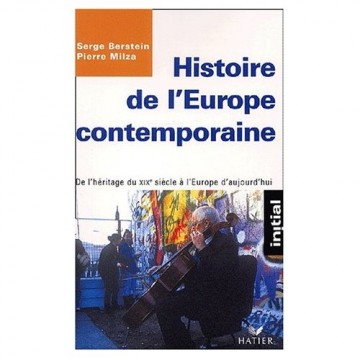
Livre histoire contemporaine Europe
HISTOIRE DE L’EUROPE
CONTEMPORAINE
Serge Berstein et Pierre Milza
A tous ceux qui ne sont pas historiens mais qui souhaitent savoir l’essentiel de l’histoire contemporaine de « vieux continent », voilà un livre incontournable.
Les deux historiens qui en sont les auteurs sont des références obligées. Dans ce livre, ils parviennent à dire l’essentiel de ce qu’il faut savoir sur le sujet en allant à l’essentiel et en évitant l’amoncellement excessif de dates et de faits.
Ce livre est avant tout une excellente vision globale de l’histoire du continent européen, permettant de remettre l’histoire française dans un contexte plus large. En effet, il n’y a pas d’histoire française sans histoire européenne, et à la lecture de ce livre, on ne peut que en prendre acte.
Comme le disait si bien le grand historien Marc Bloch (1886-1944): « Il n’y a pas d’histoire de France, il y a une histoire de l’Europe ». Je lui préfère tout de même la réponse de Fernand Braudel (1902-1985), illustre historien également : « Il n’y a pas une histoire de l’Europe, il y a une histoire du Monde. »
Voilà donc un excellent outil de travail pour historien et autres étudiants mais c’est avant tout un livre simple à la porté de tous ceux qui souhaitent mieux comprendre le monde et en particulier l’Europe d’aujourd’hui.
Michel
Source photo: http://www.amazon.fr
20:10 Posted in LIVRES | Permalink | Comments (0)